


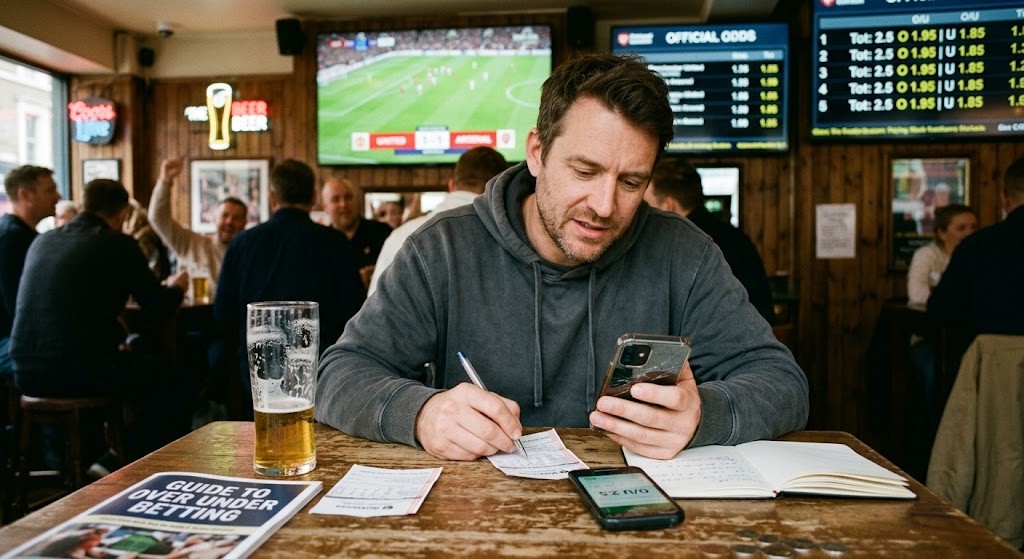
An over/under wager, officially known as a totals market, is a wager where you predict whether the combined statistical outcome of an event will be higher or lower than a figure set by the bookmaker.
Unlike moneyline or point spread markets, you do not need to pick a winning team or athlete. The focus rests entirely on the overall benchmark, such as total points scored in a basketball game, goals in a soccer match, or rounds completed in a fight.
Core Mechanics of Totals Markets
Sportsbooks set a projected line representing the combined total performance of both competitors. Participants then choose one of two positions:
- Over: Predicting the combined final tally will exceed the line.
- Under: Predicting the combined final tally will stay below the line.
Oddsmakers establish these thresholds by evaluating offensive efficiency, defensive match-ups, game tempo, weather conditions, and historical head-to-head metrics.
Example: Football Totals Wager Set Line: 47.5 Points
- Selection: OVER 47.5
- Final Score: 28 – 21 (49 Total Points) ➔ WIN
- Final Score: 24 – 20 (44 Total Points) ➔ LOSS
- Selection: UNDER 47.5
- Final Score: 24 – 20 (44 Total Points) ➔ WIN
- Final Score: 28 – 21 (49 Total Points) ➔ LOSS
Eliminating Ties with Half-Point Hooks
Lines frequently feature a decimal point, commonly referred to as the “hook” (e.g., 220.5 or 2.5). The .5 increment prevents ties, guaranteeing a decisive outcome regardless of game flow.
| Scenario | Line Set | Final Game Score | Total Score | Winning Outcome |
| Half-Point Line | 53.5 | Team A: 30, Team B: 24 | 54 | Over 53.5 |
| Half-Point Line | 2.5 | Team A: 1, Team B: 1 | 2 | Under 2.5 |
| Whole Number Line | 210.0 | Team A: 110, Team B: 100 | 210 | Push (Refund) |
When lines are published as whole numbers (e.g., 45.0 or 210.0), a total landing exactly on the benchmark results in a push in sports betting. When a push occurs, the initial stake is returned in full, as neither the over nor the under condition was met.
Odds Movement and Pricing Structures
Totals markets use standard odds pricing (typically American odds like -110 or decimal odds around 1.91) on both sides of the line. These prices represent the vigorish, or commission, retained by the bookmaker.
Plaintext
Standard Line: Over 48.5 (-110) | Under 48.5 (-110)
Risking $110 returns $100 in profit on a winning ticket.
Oddsmakers adjust lines before game time based on incoming market volume and critical information updates:
- Public Money Triggers: Heavy betting volume on one side forces books to adjust the line up or down to balance their risk.
- External Drivers: Key player injuries, sudden weather shifts (such as high winds impacting kicking games), or tactical roster rotation prompt line revisions.
Game Dynamics Across Major Sports
Different sports display unique scoring frequencies, shaping how totals are priced and structured.
- Basketball (High-Frequency Scoring):
- Typical Line: 215.5 – 235.5 Points
- Core Factors: Pace of play, offensive possessions, late-game intentional fouls
- Football (Mid-Frequency Scoring):
- Typical Line: 38.5 – 52.5 Points
- Core Factors: Red zone efficiency, weather conditions, turnover margins
- Baseball & Hockey (Low-Frequency Scoring):
- Typical Line: 5.5 – 9.5 Runs / Goals
- Core Factors: Starting pitcher matchups, goalie form, power-play conversions
Alternative and Derivative Totals
Beyond standard full-game benchmarks, sportsbooks offer specialized derivatives targeting specific segments of an event:
- Team Totals: Isolate a single team’s offensive production, ignoring the opponent’s score entirely.
- Segment Totals: Benchmark scoring strictly within the 1st Quarter, 1st Half, or a single period.
- Player Prop Totals: Wagers on individual player statistics, such as passing yards, rebounds, or strikeout counts.
Key Analytical Variables in Totals Evaluation
Successful evaluation of totals markets requires analyzing situational factors rather than relying on basic average scores:
- Pace and Possession Metrics: Fast-paced basketball teams create more field goal attempts per minute, elevating the scoring ceiling for both sides.
- Environmental Conditions: High winds dramatically reduce passing and kicking accuracy in outdoor football games, favoring lower totals.
- Rest and Scheduling: Teams playing on consecutive nights often experience defensive fatigue, leading to higher fouls and higher-scoring second halves.
3. Conclusion
Understanding how over/under betting works provides a foundation for navigating sports markets beyond traditional team-selection wagers. By focusing on overall game flow, scoring efficiency, and situational metrics, you can analyze events through a neutral lens focused entirely on pace and production.
4. Frequently Asked Questions
Does overtime count toward over/under wagers? Yes. Unless explicitly stated otherwise in a sportsbook’s house rules or specific market terms (such as “60-minute regulation only” markets in ice hockey), any points scored during overtime periods count toward the final total.
What happens to an over/under bet if a game is delayed or postponed? If a match is postponed or canceled, bets generally remain pending if the event is rescheduled within a specific timeframe (usually 24 to 36 hours). If the game is not completed within that window, wagers are voided, and stakes are refunded.
Can an over/under line change after placing a bet? Lines shift constantly due to market activity, but your wager is locked in at the specific total and odds available at the precise time your bet slip was accepted.
Why do some sportsbooks display different totals for the same game? Different sportsbooks manage risk independently based on their specific customer betting patterns and liability limits. This variance creates line shopping opportunities across different operators.
How does a live or in-game over/under bet work? In-play totals update dynamically during live action to reflect real-time scoring, clock elapsed, and momentum shifts. You can place wagers on updated live totals right up until late in the contest.
