


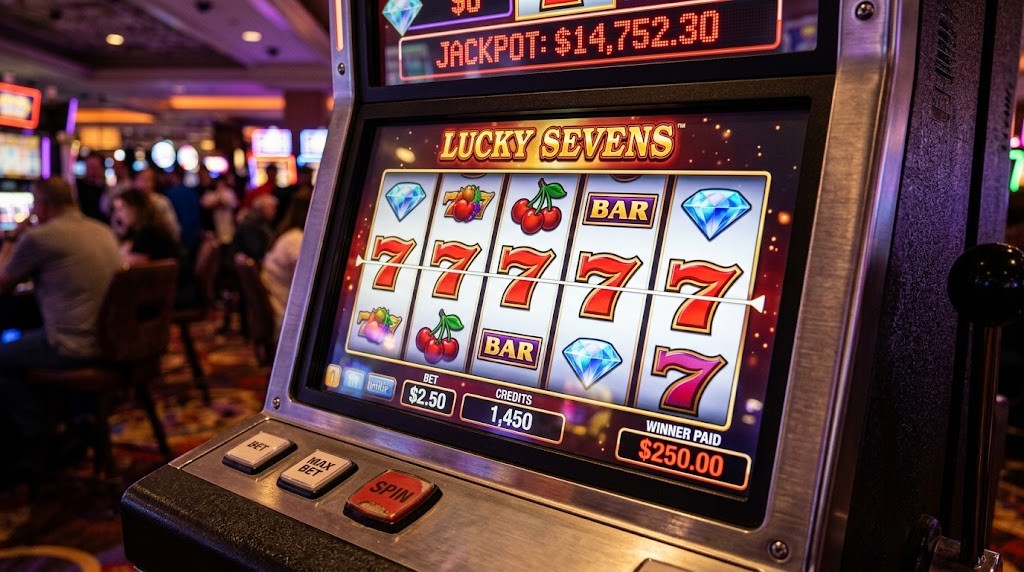
Modern slot machines are complex digital computers designed to deliver completely unpredictable outcomes while adhering to strict mathematical parameters. While early mechanical slots relied on gears, levers, and physical braking systems, contemporary casino floors and online platforms operate entirely on software-driven mechanisms. Every spin on a modern slot machine is governed by a microcomputer-controlled script known as a Random Number Generator (RNG), ensuring that every outcome is independent, unmanipulated, and purely a matter of chance.
Understanding the mechanics behind these machines requires looking past the spinning reels, flashing lights, and celebratory sound effects to examine the software and mathematics driving the game beneath the surface.
The Core Engine: Random Number Generators (RNG)
At the heart of every modern video and digital slot machine is a Random Number Generator (RNG). An RNG is a microprocessor-based algorithm that continuously generates sequences of simulated random numbers at a speed of hundreds or thousands of integers per second, even when nobody is playing the machine.
The exact moment a player hits the “Spin” button or pulls the handle, the software registers the precise number generated by the RNG at that millisecond. That specific number corresponds directly to a predetermined combination of symbols on the virtual reels.
Key principles governing slot RNGs include:
- Total Independence: Previous spins have zero influence on future spins. A machine that has not paid out in hours is no more likely to hit a winning combination on the next spin than one that just paid out a jackpot.
- Constant Operation: The generator runs continuously, split-second by split-second, whether the machine is active or idle.
- Non-predictability: The mathematical algorithms are designed and audited by third-party testing labs to prevent human prediction or systematic tracking.
Because the outcome is determined instantly when the button is pressed, the visual animation of the reels spinning on the screen is merely an entertaining graphical representation designed for engagement.
Virtual Reels and Stop Mapping
Classic mechanical slots were physically limited by the size of their reels. A standard mechanical reel could comfortably fit around 20 symbols. If a machine had three reels with 20 symbols each, the total number of unique combinations was limited to $20 \times 20 \times 20 = 8,000$ possibilities. This made offering massive progressive jackpots mathematically impossible without setting the payout odds unprofitably high.
In the 1980s, the introduction of virtual reel mapping revolutionized slot machine design. Virtual mapping allows the computer software to simulate reels containing hundreds of virtual stops for each physical or displayed reel symbol.
| Physical Symbol Shown | Virtual Reel Stops Assigned | Probability of Selection |
| Low-Value Symbol (e.g., Cherry) | 25 Virtual Stops | High Probability |
| Medium-Value Symbol (e.g., Bar) | 8 Virtual Stops | Medium Probability |
| Jackpot Symbol (e.g., 7 or Wild) | 1 Virtual Stop | Extremely Low Probability |
By assigning uneven quantities of virtual stops to different symbols, slot developers can offer massive potential payouts while ensuring that high-value symbols land far less frequently than standard symbols.
The Mathematical Framework: RTP and Volatility
Every slot machine is coded with a built-in mathematical advantage for the house, structured through two core variables: Return to Player (RTP) percentage and Volatility.
Return to Player (RTP)
The Return to Player percentage represents the theoretical percentage of all wagered money that a slot machine will pay back to players over a long period—typically millions of spins. For example, if a machine features a 96% RTP, it is mathematically configured to retain $4 for every $100 wagered over its operational lifecycle.
It is vital to understand that RTP operates over massive statistical sample sizes. In a single session of 50 spins, a player’s actual return can range from 0% to several thousand percent of their initial bankroll.
Game Volatility (Variance)
Volatility describes the frequency and distribution size of payouts:
- High Volatility: Payouts occur less frequently, but individual win amounts tend to be larger.
- Low Volatility: The machine yields frequent winning combinations, but individual payouts are generally small.
- Medium Volatility: A balanced distribution offering steady small wins punctuated by occasional moderate payouts.
How Paylines and Multi-Line Wagers Work
Traditional slots featured a single horizontal payline across the center of three physical reels. Modern video slots offer complex payline structures ranging from 10 to over 100 distinct lines across five or more reels. Modern formats also feature mechanisms like “Ways to Win” (e.g., 243 or 1,024 ways) or cluster-based payouts, where matching symbols pay out anywhere as long as they are adjacent.
When playing multi-line games, the RNG evaluates every active line independently against the game’s paytable. A single spin can trigger multiple winning paylines simultaneously, combining the total payout credited to the player’s balance.
Conclusion
Strip away the themes, graphics, and audio, and every slot machine is fundamentally an exercise in applied mathematics. Driven by continuous Random Number Generators and governed by virtual reel mapping, slot machines guarantee unpredictable outcomes on every individual spin while maintaining fixed house advantages over the long term. Understanding these underlying mechanics allows players to clearly grasp how outcomes are generated, separating mathematical reality from common gaming myths.
Frequently Asked Questions
Does pressing the stop button early change the outcome of a spin?
No. The outcome of the spin is determined the exact millisecond you initiate the bet. Pressing the physical or virtual stop button merely speeds up the visual animation of the reels stopping; it does not alter the underlying number selected by the RNG.
Can a casino alter a slot machine’s payout percentage remotely during play?
No. Casino operators cannot change a machine’s Return to Player (RTP) setting on the fly or during an active session. Regulatory rules require strict protocol, including taking the game offline, logging the change with regulatory bodies, and following mandated administrative procedures before software parameters can be adjusted.
Does playing with a player rewards card lower the payout odds?
No. The player rewards system and the slot engine operate on entirely separate software architectures. Inserting a player card tracks coin-in for loyalty points but has zero access to or influence over the machine’s Random Number Generator or payout odds.
Are online slot machines programmed differently than physical land-based slots?
The core mechanics are identical. Both online and physical video slot machines rely on software-driven Random Number Generators, virtual reel mapping, and predetermined RTP settings. The primary difference lies in the interface: online games execute code on remote servers, whereas physical machines run code on internal microprocessors.
Why do some symbols appear to land just one stop away from a winning combination so often?
This phenomenon is known as a “near-miss.” Because virtual reels assign significantly more virtual stops to the spaces immediately adjacent to a high-paying symbol, those neighboring blank spaces land far more often than the jackpot symbol itself, creating the visual impression that a win was narrowly missed.
